
Real or Fake?
A common debate I see all the time when it comes to reptile keeping and terrarium management. What type of rock to use?
Well, when it comes to heating and heat retention, I decided to do a comparison between the real and fake. What I found, well, was unexpected.
If you want to skip the jargon, scroll to the bottom where I have the charts to see what the results are. If you want to know how I got these readings, then stick around and enjoy the read.
I decided to keep as close to an apples to apples comparison between the real and fake rock. So I used a slate rock as my choice and a grey fake rock as its competitor. While I know weight can have an impact on thermodynamics, I found it almost impossible to find a slim enough real rock or a large enough fake rock to keep the weights the same. So, for the test, I decided to keep the size and shape as close as I can. The fake rock weighed in at 0.328 lbs. (148.7783 grams) and the real rock weighed in at 1.025 lbs. (464.932 grams).
The test was rather easy, but it took a long time, 12 hours to be exact. The setup was the same, a 5 gallon tank with a heat bulb and emitter hanging 6 inches above the lid. The bulb and emitter both were rated at 75 watts of output. From room temperature of 70 degrees F., I ran the same test 3 different times. Test one was always the control test, which was just Reptisoil, tests two and three were the rocks. I turned on the power and measured the temperature every 5 minutes until 30 minuets had passed. Then I would turn the power off and repeat the process, no matter if the soil or rock had hit room temperature or not.
For context, I did measure the whole area that was affected by the bulb or emitter, the heat dissipation was roughly the same throughout the whole surface area of the rocks, plus or minus a degree which would I classified as a margin of error, so I disregarded it. Had there been a larger difference in heat around the surface of the rocks, I would have noted that and put it in my findings.
And here is what I found.
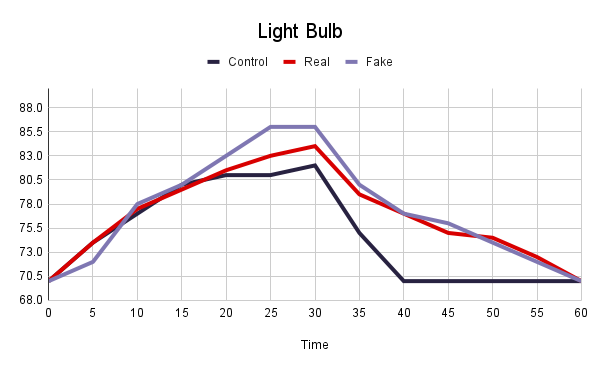
As we can see, the light bulb has a longer sustained heat with both rocks
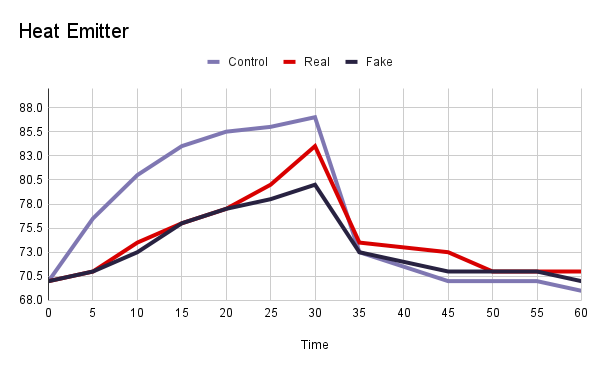
Unlike the light bulb, once the heat emitter is off, all temps quickly go down
So, my conclusion is this. There is no real difference between the two rocks themselves. There is a slight difference between a heat bulb and emitter, however that would be a test for the future on which is better. For the sake of the rocks, I would say there is no real difference between the two.
